总体特点
- 主题化: 每个单元都有一个核心主题,如日常生活、食物、家务、周末活动等。
- 情景化: 对话和短文都设置在具体的生活场景中,方便学生理解和模仿。
- 句型化: 重点突出核心句型,并围绕句型进行词汇和语法的拓展。
- 螺旋式上升: 在四年级的基础上,引入更复杂的时态(如现在进行时)、更丰富的词汇和更长的语篇。
各单元核心内容概览
以下是五年级上册通常包含的单元主题和重点内容:
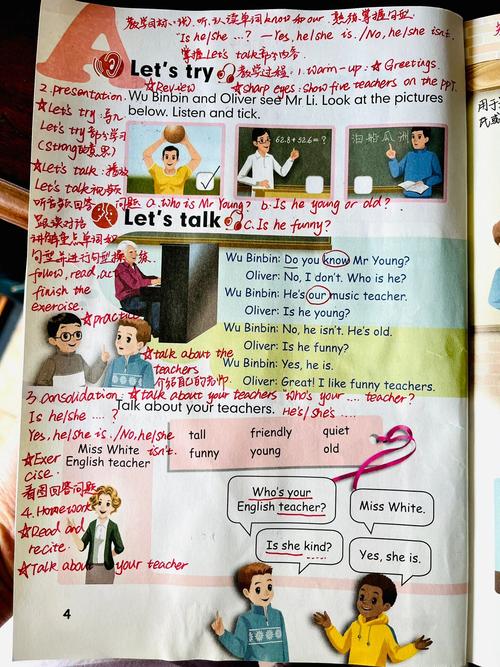
Unit 1 What's he like? (他/她长什么样?)
- 核心主题: 描述人物的性格和外貌。
- 重点词汇:
- 形容词:
kind(和蔼的),strict(严格的),funny(有趣的),polite(有礼貌的),hard-working(勤奋的),helpful(乐于助人的) - 身体部位:
young(年轻的),old(年老的),tall(高的),short(矮的),strong(强壮的),thin(瘦的),heavy(重的)
- 形容词:
- 核心句型:
- 询问人物特征:
— Who's your art teacher?— Mr. Jones.— What's he like?— He's very kind.
- 描述人物特征:
Is he young?— Yes, he is. / No, he isn't.She's very strict, but she's very kind.
- 询问人物特征:
- 课文场景:
- 主要围绕学生和老师之间的对话展开,讨论新来的各科老师的性格和外貌特点。
- 示例对话:
A: Who's your math teacher? B: Mr. Young. A: Is he strict? B: Yes, he is. But he's very funny.
Unit 2 My week (我的一周)
- 核心主题: 讨论一周的课程和课外活动。
- 重点词汇:
- 星期:
Monday,Tuesday,Wednesday,Thursday,Friday,Saturday,Sunday,weekend - 课程:
math,Chinese,English,music,art,PE(Physical Education),science - 活动:
do homework,watch TV,read books,wash my clothes,play football
- 星期:
- 核心句型:
- 询问星期课程:
— What do you have on Mondays?— We have English, math and music.
- 描述周末活动:
— What do you do on Saturdays?— I often watch TV and play ping-pong with my father.— Do you often read books on Sundays?— Yes, I do. / No, I don't.
- 询问星期课程:
- 课文场景:
- 两个同学互相询问彼此的课程表,并分享自己周末的安排。
- 示例短文:
I often read books on Saturdays. In the evening, I watch TV with my family. On Sundays, I do my homework and then I play football. I love my weekend!
Unit 3 What would you like? (你想要什么?)
- 核心主题: 在餐厅点餐,谈论自己喜欢的食物。
- 重点词汇:
- 食物:
sandwich,salad,hamburger,ice cream,tea,fresh,healthy,delicious - 饮料:
water,juice,milk,tea - 动词:
would like,drink,eat
- 食物:
- 核心句型:
- 点餐:
— What would you like to eat/drink?— I'd like a sandwich, please.(I'd like = I would like)— Anything else?— No, thanks.
- 表达喜好:
— I like salad. It's healthy.— I don't like hamburgers. They're not healthy.
- 点餐:
- 课文场景:
- 在餐厅里,顾客和服务员之间的点餐对话。
- 示例对话:
Waiter: Hello! What would you like to eat? Chen Jie: I'd like a sandwich, please. Waiter: What would you like to drink? Chen Jie: I'd like some tea, please.
Unit 4 What can you do? (你会做什么?)
- 核心主题: 谈论个人能力,特别是在学校活动中的特长。
- 重点词汇:
- 动词短语:
sing English songs,do kung fu,dance,draw cartoons,play the piano,swim,speak English - 其他:
party,show,for
- 动词短语:
- 核心句型:
- 询问能力:
— What can you do?— I can sing English songs.
- 确认/否定能力:
— Can you do any kung fu?— Yes, I can. / No, I can't.— No problem! I can help you.
- 询问能力:
- 课文场景:
- 同学们在为班级联欢会(party)准备节目,互相询问对方会什么才艺。
- 示例对话:
Oliver: We'll have an English party next Tuesday! What can you do for the party, Mike? Mike: I can sing English songs. Oliver: Great! Can you do any kung fu? Mike: No, I can't.
 (图片来源网络,侵删)
Unit 5 There is a big bed. (这里有一张大床。)
- 核心主题: 描述房间内的物品及其位置。
- 重点词汇:
- 家具:
bed,table,sofa,chair,phone,book,photo - 位置介词:
in,on,under,near,behind,in front of
- 家具:
- 核心句型:
- 介绍房间里有什么:
— There is a big bed.— There are so many pictures here.
- 询问物品位置:
— Where is the ball?— It's in front of the dog.— Where are the keys?— They're on the table.
- 介绍房间里有什么:
- 课文场景:
- 朋友参观新房间,主人介绍房间里有什么东西以及它们的位置。
- 示例短文:
This is my new room. There is a big bed, a desk and a chair. The desk is near the window. My books are on the desk. There is a photo on the wall. I love my room!
Unit 6 In a nature park. (在自然公园里)
- 核心主题: 描述自然公园里的景物。
- 重点词汇:
- 自然景物:
forest,river,lake,mountain,hill,tree,bridge,building,path - 动词:
go boating,climb mountains,play games
- 自然景物:
- 核心句型:
- 询问和确认是否存在:
— Is there a river in the park?— Yes, there is. / No, there isn't.— Are there any tall buildings in the nature park?— No, there aren't.
- 描述景物:
There is a high mountain in the park.There are many small fishes in the lake.
- 询问和确认是否存在:
- 课文场景:
- 一家人或朋友们在自然公园里游玩,讨论公园里有什么景物。
- 示例对话:
Chen Jie: Look at the picture. Is there a river in the park? Oliver: Yes, there is. There is a bridge over the river. Chen Jie: Are there any boats on the lake? Oliver: Yes, there are. They're so beautiful!
学习建议
- 情景记忆: 不要孤立地背单词和句型,而是结合课文对话的场景来理解和记忆,想象自己就是对话中的角色。
- 角色扮演: 和同学或家长一起分角色朗读课文,甚至可以改编对话,这是练习口语和语感的最佳方式。
- 主题归纳: 每个学完后,把单元相关的词汇和句型整理在一起,形成一个“话题包”,方便复习和运用。
- 听力输入: 反复听课文配套的录音,模仿语音语调,培养语感。
希望这份详细的总结能帮助您和孩子更好地理解和学习五年级上册的英语课文!