标准版 (Standard Version)
Myopia: A Common Problem Among Teenagers**
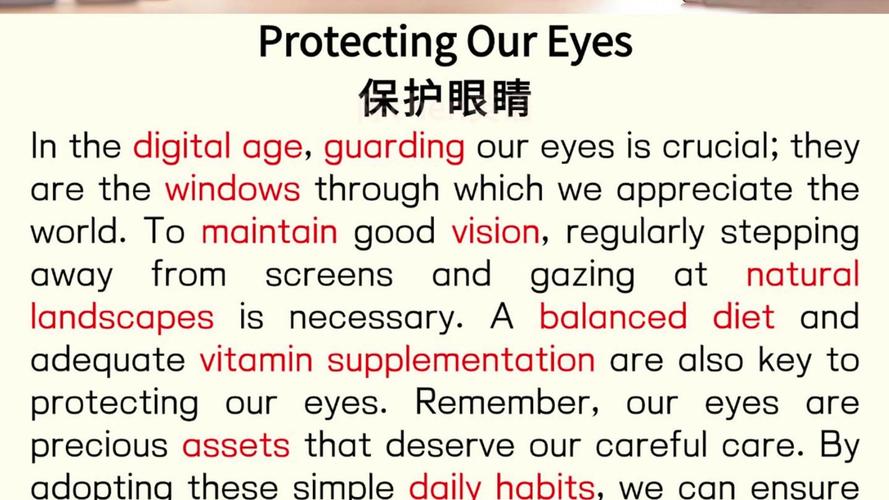
In today's world, it is hard to find a classroom where every student has perfect vision. Myopia, or nearsightedness, has become a very common problem, especially among teenagers like us. There are several reasons for this growing trend, and it is important for us to understand them and take action.
The main cause of myopia is too much time spent on near-work activities. We spend hours every day reading books, doing homework, and, most importantly, staring at screens like computers, tablets, and mobile phones. Our eyes get tired from focusing on things that are so close for such a long time. Another significant factor is a lack of outdoor activities. When we are outside, our eyes are forced to look at distant objects, which helps to relax the eye muscles. Unfortunately, many of us prefer to stay indoors and play video games or chat with friends online.
The effects of myopia are more serious than just needing to wear glasses. Blurry vision can make it difficult to see the blackboard clearly in class, affecting our studies. In our daily lives, simple things like recognizing a friend's face from far away or enjoying a beautiful view become challenging. More importantly, severe myopia can lead to long-term eye health problems in the future.
Therefore, we must take steps to protect our eyes. First, we should follow the "20-20-20" rule: every 20 minutes of screen time, look at something 20 feet away for 20 seconds. Second, we need to spend at least one or two hours outdoors every day. Finally, maintaining a good reading posture and ensuring there is enough light when we study are also crucial habits.
Our eyes are the windows to the world. Let's start taking better care of them now to ensure we have a bright and clear future.
个人经历版 (Personal Experience Version)
Life Through My Lenses**
I still remember the day clearly. It was in the middle of a math class, and I couldn't read the numbers on the blackboard. Squinting my eyes didn't help; everything was just a blurry mess. That was the moment I realized I had myopia. Getting my first pair of glasses was both a relief and a new challenge.
For a while, I was actually happy with my glasses. They were like a magic key that unlocked a clear world for me. I could finally see the leaves on the trees and the expressions on my teachers' faces. However, the novelty soon wore off. The biggest problem was sports. I was always afraid my glasses would fall off or break during a game of basketball. On rainy days, my lenses would get foggy, and I couldn't see anything at all. It was really frustrating.
Myopia has taught me the importance of eye care. I now understand that it wasn't just bad luck; it was a result of my bad habits. I used to read in bed with my phone for hours, and I rarely went outside. Now, I am much more careful. I make sure to take breaks from my screen, I spend more time playing outside with my friends, and I always remind myself to maintain the correct distance from my books.
Wearing glasses has become a part of my life, but it has also made me appreciate my eyes more. I hope that other students can learn from my experience and protect their vision before it's too late. After all, seeing the world clearly is a gift we should all cherish.
问题解决版 (Problem-Solution Version)
Beating the Myopia Epidemic: What Can We Do?**
Across the globe, the number of people with myopia is rising at an alarming rate, creating what many experts call a "myopia epidemic." This is especially true for young people. If we don't act now, this problem will only get worse. So, what is causing this, and more importantly, what can we do to solve it?
The root causes of the myopia epidemic are clear. Our modern lifestyle is largely to blame. The combination of heavy academic workloads and the allure of digital entertainment has led us to spend an excessive amount of time indoors and up close. Our eyes are not designed for this constant, near-focus strain. Without enough time spent looking at distant objects, our eyeballs can grow too long, causing light to focus in front of the retina instead of on it, which results in blurry distance vision.
The solution lies in changing our daily habits. The most effective way to prevent and even slow down the progression of myopia is to increase our time outdoors. Natural light is believed to be beneficial for eye development. Health organizations recommend at least 60-60 minutes of outdoor activity per day for children and teenagers. Secondly, we must practice good "eye hygiene." This includes following the "20-20-20" rule for screen use, ensuring our study areas are well-lit, and maintaining a proper reading posture.
Schools and parents also play a vital role. Schools should encourage more outdoor breaks and sports, while parents should set limits on screen time and act as role models by spending time outdoors with their children. Protecting our eyesight is a shared responsibility.
By taking these simple but effective steps, we can fight against the myopia epidemic and ensure that future generations can enjoy the beauty of the world with clear, healthy vision.
重点词汇与短语 (Key Vocabulary & Phrases)
Nouns (名词):
- Myopia / Near-sightedness: 近视
- Vision / Eyesight: 视力
- Screen: 屏幕 (指电脑、手机等)
- Posture: 姿势
- Retina: 视网膜
- Epidemic: (疾病等)蔓延,流行病
Verbs (动词):
- Squint: 眯着眼睛看
- Focus (on): (使)聚焦于
- Affect: 影响
- Lead to: 导致
- Cherish: 珍视
Adjectives (形容词):
- Blurry / Fuzzy: 模糊的
- Severe: 严重的
- Significant: 重要的,显著的
- Constant: 持续不断的
- Alarming: 令人担忧的
Useful Phrases (实用短语):
- Windows to the world: 看世界的窗户
- 20-20-20 rule: 20-20-20法则 (每20分钟,看20英尺外20秒)
- Eye hygiene: 用眼卫生
- Take action / Take steps: 采取行动
- A growing trend: 一个日益增长的趋势
- Be responsible for: 对...负责
- Learn from one's experience: 从某人的经历中学习
希望这些范文和词汇对你的英文写作有帮助!